


FAQ
Table of Contents
1. QUESTIONS ABOUT SHIPPING
- 1.1 Which countries do we deliver to?
- 1.2 How long does shipping take?
- 1.3 What are the shipping costs?
- 1.4 Where is my package?
- 1.5 My package is missing - what now?
- 1.6 Can I exchange an item?
2. QUESTIONS ABOUT PAYMENT
- 2.1 What payment methods can I use?
3. RETURNS AND EXCHANGES
- 3.1 What do I need to consider for returns and refunds?
- 3.2 When will I receive my refund?
4. QUESTIONS ABOUT ORDERING
4.1 How does ordering work?
5. KNIFE KNOWLEDGE
5.1 What does "HRC" mean?
5.2 What steels are used by our manufacturers?
- 5.2.1 ZDP-189
- 5.2.2 SG2
- 5.2.3 VG-10
5.3 Blade steel properties
- 5.3.1 Properties of High-Performance Steels
- 5.3.2 Wear Resistance
- 5.3.3 Strength
- 5.3.4 Toughness
- 5.3.5 Rust Resistance
- 5.3.6 Edge Retention
- 5.3.7 Knife Usage No-Go's
- 5.3.8 What are the differences between Japanese and European knives?
- 5.3.9 How does a knife become dull and what can be done about it?
6 KNOWLEDGE ABOUT SHARPENING
- 6.1 What is the difference between honing and sharpening?
- 6.2 When do I use which sharpening stone grit?
- 6.3 When do I use which sharpening tool?
1. QUESTIONS ABOUT SHIPPING
1.1 Which countries do we deliver to?
We ship to Germany and Austria.
1.2 How long does shipping take?
-
For orders within Austria, unless otherwise specified and depending on stock availability, delivery time is 2 - 4 business days. We usually ship your order on the same day. ATTENTION! Please note that delivery times may vary for some products (e.g., Nesmuk, due to high demand)
-
For orders within Germany, delivery time is approximately 2-4 business days. To Germany, 3-5 business days. We usually ship your order on the same day. ATTENTION! Please note that delivery times may vary for some products (e.g., Nesmuk, due to high demand)
1.3 What are the shipping costs?
It's simple: For purchases over €100,- shipping is free. Below that amount, it costs 4.90€ for customers from Austria and 9.90€ for customers from Germany.
1.4 Where is my package?
Once your package has been shipped, you will receive an email with your tracking number. You can use this tracking number to follow the shipping status of your order directly on the shipping service provider's website.
1.5 My package is missing - what now?
Sometimes a package does not arrive. In such a case, it is always advisable to file an inquiry with the shipping service provider. If your order has not reached you, please email us at shop@klingen-boutique.at and we will arrange a quick solution.
1.6 Can I exchange an item?
To exchange an item, the easiest way is to send back the unwanted item and order the desired one. You can do this quickly and easily with our returns form. As soon as the returned item has arrived, we will issue you a credit note.
2. QUESTIONS ABOUT PAYMENT
2.1 What payment methods can I use?
You can select your preferred payment method at checkout. We offer a range of reliable payment providers that are already established in the market.
-
We accept secure payments for both local and international customers via credit card, debit card, and PayPal.
3. RETURNS AND EXCHANGES
3.1 What do I need to consider for returns and refunds?
Your 100% satisfaction is important to us. We offer a 30-day return and exchange policy:
-
If a product is damaged or faulty upon delivery - we offer a 100% refund.
-
Timing: We offer a 30-day return and exchange policy from the day you received the item.
-
For a return to be eligible, items must be unopened, unused, and undamaged.
-
For returns, please email shop@klingen-boutique.at with the subject "Returns" and include your order number, name, and reason for return.
-
Please print out the return label you receive from us and stick it on the package to be shipped. Please request a shipping confirmation from your carrier to avoid "lost packages".
-
Please note that you are responsible for the shipping costs of returned items.
-
Once the returned item(s) have been received and inspected, you will receive a confirmation email informing you of the refund status.
-
If the refund is approved, a credit will automatically be applied to your account.
For any questions, please feel free to contact us at shop@klingen-boutique.at.
3.3 When will I receive my refund?
Please allow us some time for the careful processing of returns. We will process your return as quickly as possible after it arrives at our warehouse, and you will receive your refund via the payment method used in the online shop within a maximum of 14 days.
4. QUESTIONS ABOUT ORDERING
4.1 How does ordering work?
Simply add as many items as you wish to your shopping cart while browsing our shop. When you are ready to proceed with the order, go to the shopping cart and click "Checkout." Follow the instructions by providing your delivery information and selecting the payment method for the goods - we will ship your package as quickly as possible.
5. KNIFE KNOWLEDGE
5.1 What does "HRC" mean?
HRC stands for Hardness Rockwell C (cone). It is a testing method used to determine the hardness of a material. A diamond cone is pressed into the material. The depth of penetration indicates how hard the material is. The shallower the penetration, the harder the material, and the higher the HRC number.
5.2 What steels are used by our manufacturers?
5.2.1 ZDP-189/MC66:
A high-alloy, stainless high-performance steel from Hitachi. It is the hardest blade steel on the market, with a hardness of 66 HRC. This high-end steel owes its desirable microstructure properties to the powder metallurgical manufacturing process. This manufacturing method allows for the predetermined and standardized microstructure of the steel, resulting in a steel with very low tolerance fluctuations and desirable microstructure properties: fineness and homogeneity.
5.2.2 SG2/MC63:
Powder metallurgical SG2 steel (Super Gold 2) is also referred to as SGPS. It has a very fine, homogeneous microstructure, achieved through the powder metallurgical manufacturing process. Japanese SG2 steel has a high carbon content and is a high-alloy, stainless steel. The hardness of this steel is very high at 63 HRC. The Elegancia series by Suncraft, Miyabi's 6000MCT and 5000MCD-B series use this steel.
5.2.3 VG-10/MC61:
The evergreen. A very good, rust-resistant steel. It is often used for the cutting layer in Japanese kitchen knives. Most Japanese blades with VG-10 are around 61 HRC. It requires minimal care to prevent corrosion. It has a very good edge and is easy to sharpen. Robust cutting edge despite high hardness. Suncraft uses this steel in the following series: Senzo Classic, Senzo Twisted Octagon, Senzo Black.
5.3 Blade Steel Properties
5.3.1 Properties of High-Performance Steels:
What are we actually looking for in a steel? Well, what we are looking for is strength, toughness, wear resistance, and edge retention. Sometimes we also look for corrosion resistance.
5.3.2 Wear Resistance:
Refers to the steel's resistance to abrasion. Generally, the amount, type, and distribution of carbides in the steel determine wear resistance. So, it can be said that the harder the knife, the better its edge retention.
5.3.3 Strength:
The ability of the steel to withstand stress without permanent deformation. For many applications, strength is extremely important. Every time something hard is cut or lateral pressure is applied to the edge, strength becomes a critical factor. For kitchen knives, strength against hard cutting material is particularly important, as one should not make lateral movements when cutting, because this dulls the knives faster and can damage the blade. For outdoor knives, it is important that they can withstand lateral pressure and impact energy.
5.3.4 Toughness:
The ability to withstand impact without damage, i.e., without chipping, cracking, etc. Toughness is naturally important for tasks like chopping, but it is also relevant whenever the knife encounters harder contaminants in the material to be cut. In summary: The optimal blade steel for kitchen knives should have sufficient strength on the one hand and a certain toughness on the other, so that the edge is stable enough and retains its sharpness.
5.3.5 Rust Resistance:
The ability to resist rust (oxidation). Knives with poor corrosion resistance tend to develop stains on the blade. If left untreated, severe pitting can occur, but not only that: the edge is also affected, because the edge is the thinnest part of a knife and will "rust away" first. Therefore, it is important to choose the right blade steel.
5.3.6 Edge Retention:
The ability of a blade to hold an edge. Many people mistakenly think that wear resistance and edge retention are one and the same. However, this is not the case, or rather, it is usually not the case. Edge retention results from wear resistance, strength, and toughness. Different uses require different properties for edge retention. For example, when cutting through cardboard (which often has hard embedded contaminants), toughness becomes extremely important, as micro-chipping is often the reason for edge degradation. When cutting very hard wood, strength is very important for edge retention, as the main reason for the degradation of edge quality is edge bending and impact. Wear resistance becomes more important for edge retention when very abrasive materials, such as carpet, are cut. And in many tasks where corrosion-inducing materials come into contact (such as food preparation), corrosion can quickly affect the edge, so corrosion resistance also plays a role.
5.3.7 NO-GO'S WHEN USING KNIVES
-
Cutting on an unsuitable surface such as glass or stone significantly reduces the lifespan of a knife. It is best to use wood (end-grain is optimal) or plastic.
-
Washing knives in the dishwasher.
-
Wiping off cut food with the blade can unnecessarily shorten the lifespan of a knife because it "folds" the edge. Instead, use the spine of the knife.
-
Do not cut anything frozen or bones unless the tool (usually not a knife) is designed for it.
-
Store your knives in a blade guard, on a magnetic strip, or in a knife block so that the knives do not collide with each other in the drawer.
-
Also, for your health's sake, do not open cans or hard plastic packaging. For this, there are, for example, kitchen shears.
-
Do yourself a favor and do not buy cheap knives from the hardware store or supermarket. Generally, only inferior knives are offered there. Initially, these "knives" can be very cheap and function satisfactorily, but the joy of these products quickly fades, and their maintenance and repurchase are much more costly than treating yourself to a good knife once.
5.3.8 How does a knife actually become dull and what can you do about it?
Firstly, the rate of wear depends on the technical properties of a knife: the harder and finer the cutting layer, the longer the knife stays sharp. The cutting angle and the intended use of the knife also influence how long it stays sharp. Secondly, sharpness depends on handling.
Below is a list of things to avoid:
-
Cutting on an unsuitable surface such as glass or stone significantly reduces the lifespan of a knife. It is best to use wood (end-grain is optimal) or plastic.
-
Washing knives in the dishwasher:
There are several reasons why knives should be washed by hand rather than in the dishwasher.
In the dishwasher, your beloved kitchen knife is exposed much longer to an aggressive, highly concentrated dishwasher detergent, which is dissolved with salt to soften the water and can only take effect at a much higher temperature. Almost every knife enthusiast who has enjoyed a vacation by the sea and consequently experienced the effects on their knives has experience with the corrosive (rusting) effect of salt: rust spots on the edge and a very rapid loss of sharpness.
Visually, you often don't see rust spots or similar after washing, but the handle and the invisible cutting edge, which is only a few micrometers thick, are "washed away" by washing in the dishwasher. The edge retention of a knife can therefore be extended by many years without having to go to a specialist if it is regularly stropped and not put in the dishwasher.
Therefore, if you care about your knives, you should rather give them a hand wash with the SOFT side of the sponge for a minute.
-
Wiping off cut food with the blade can unnecessarily shorten the lifespan of a knife because it "folds" the edge.
-
Do yourself a favor and do not buy cheap knives from the hardware store or supermarket. Generally, only inferior knives are offered there. Initially, these "knives" can be very cheap and function satisfactorily, but the joy of these products quickly fades, and their maintenance and repurchase are much more costly than treating yourself to a good knife once.
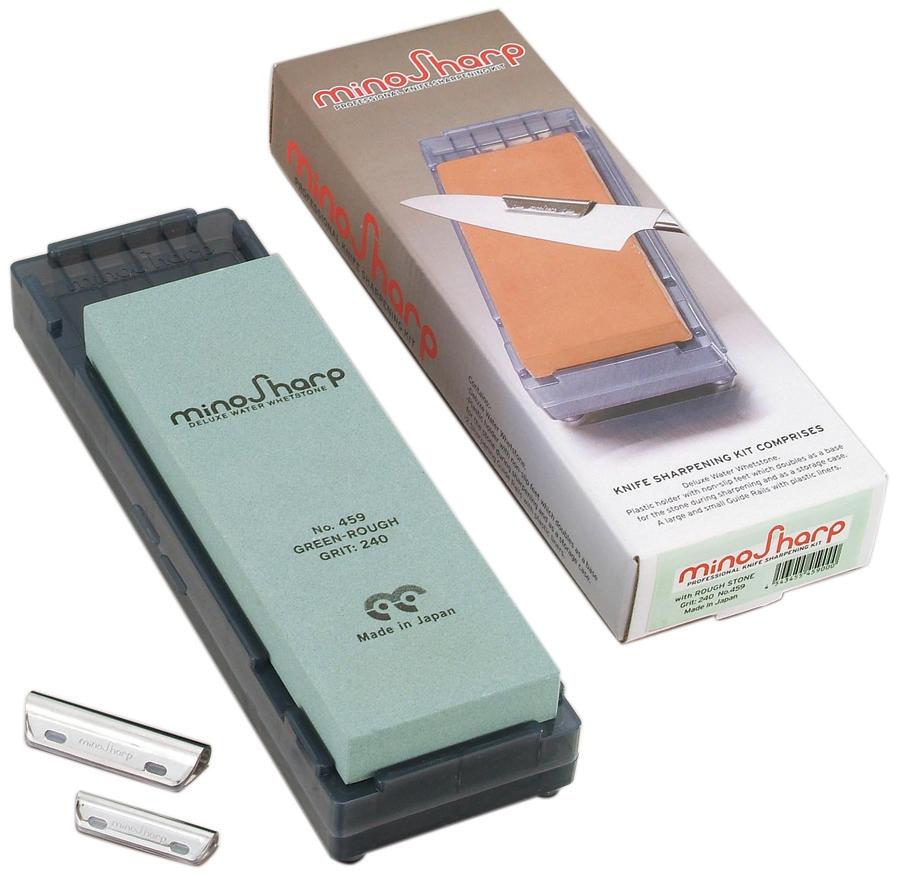
Even if you avoid these four mistakes, unfortunately, you cannot prevent a knife from dulling over time. Just as constant dripping hollows out a stone, a knife also dulls over time even with correct use. How does this happen? The thinnest area of a knife is the cutting edge. This (invisible) area "bends" over time and must be regularly straightened by stropping. Stropping the knife with a honing steel (sapphire, ceramic, diamond-coated, or tungsten carbide) or a water or oil stone works very well for a certain period and can significantly extend the functionality of a knife, but eventually the edge becomes so rounded that the cutting geometry can only be restored with a water or oil sharpening stone. For the basic grind, it is best to use a sharpening stone with a grit of 240 and then work with finer grits (starting at 1000) to achieve a razor-sharp edge that brings great joy again.
5.3.9 What are the differences between Japanese and European knives?
Basically, unless it's handmade or a special edition, Japanese knives generally have the following advantages over their European counterparts:
Japanese knives are harder and therefore have higher edge retention. An exception are chef's knives from the Japanese manufacturer Global (except the SAI series), which are designed for the European market and are as hard as European chef's knives. Otherwise, Japanese knives are usually constructed with three or more layers. In the middle is the hard cutting layer, flanked by one or more layers of softer steel. These layers protect and stabilize the hard cutting layer and create a beautiful pattern. This technique is also called San Mai. The use of high-quality steel also offers another advantage. Due to the finer structure of the steel, it can be forged thinner and subsequently ground thinner. This has the advantage of less resistance when cutting and also results in a finer cut surface on the food itself. This is noticeably evident when cutting onions, for example, as you have to "cry" less. Another difference is that all Japanese knives can be maintained at home because no authentic Japanese knife has a bolster at the blade base. This is the thickening that is present on almost all European knives. This bolster prevents you from keeping the entire blade sharp, because firstly, you would damage your whetstone trying to straighten the bolster, and secondly, it would take a very long time to do so.
6. ALL YOU NEED TO KNOW ABOUT SHARPENING
6.1 What is the difference between honing and sharpening?
Honing refers to the act of straightening a bent knife edge. The bending of the edge can be caused by various processes. Most often, this happens when you push the cut food into the pan with the edge instead of the spine of the knife. Even standard cutting causes the edge to gradually bend. This is when a honing steel or a sharpening stone is used. However, if a knife can no longer be sharpened by honing, the only option is to go to a professional or use a sharpening stone with the appropriate grit. Generally, a grit of 240 is used for this.
6.2 When do I use which sharpening stone grit?
Summary of grits (Japanese standard, JIS scale):
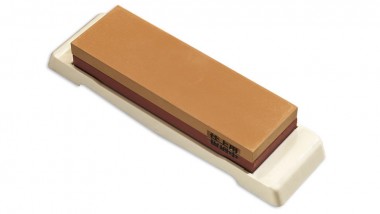
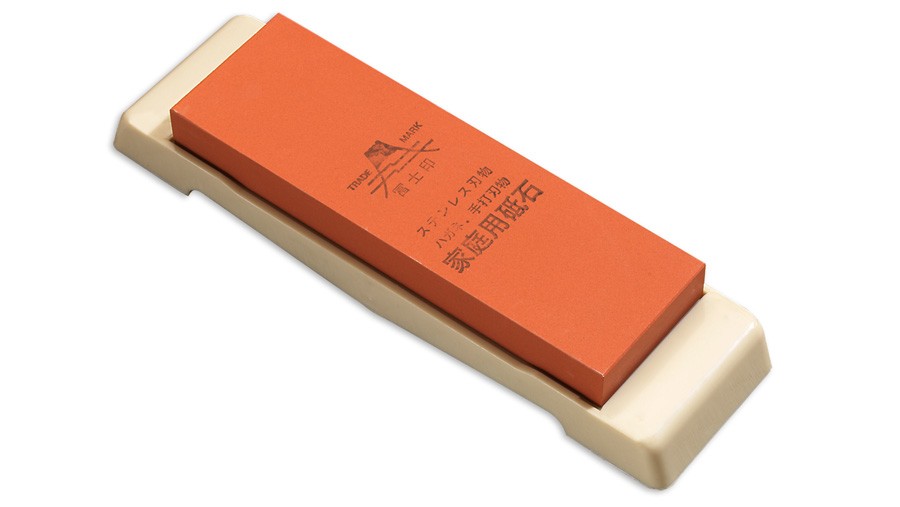
JIS240: For rough preliminary sharpening, to restore the cutting edge geometry. For particularly dull knives or knives with chips.
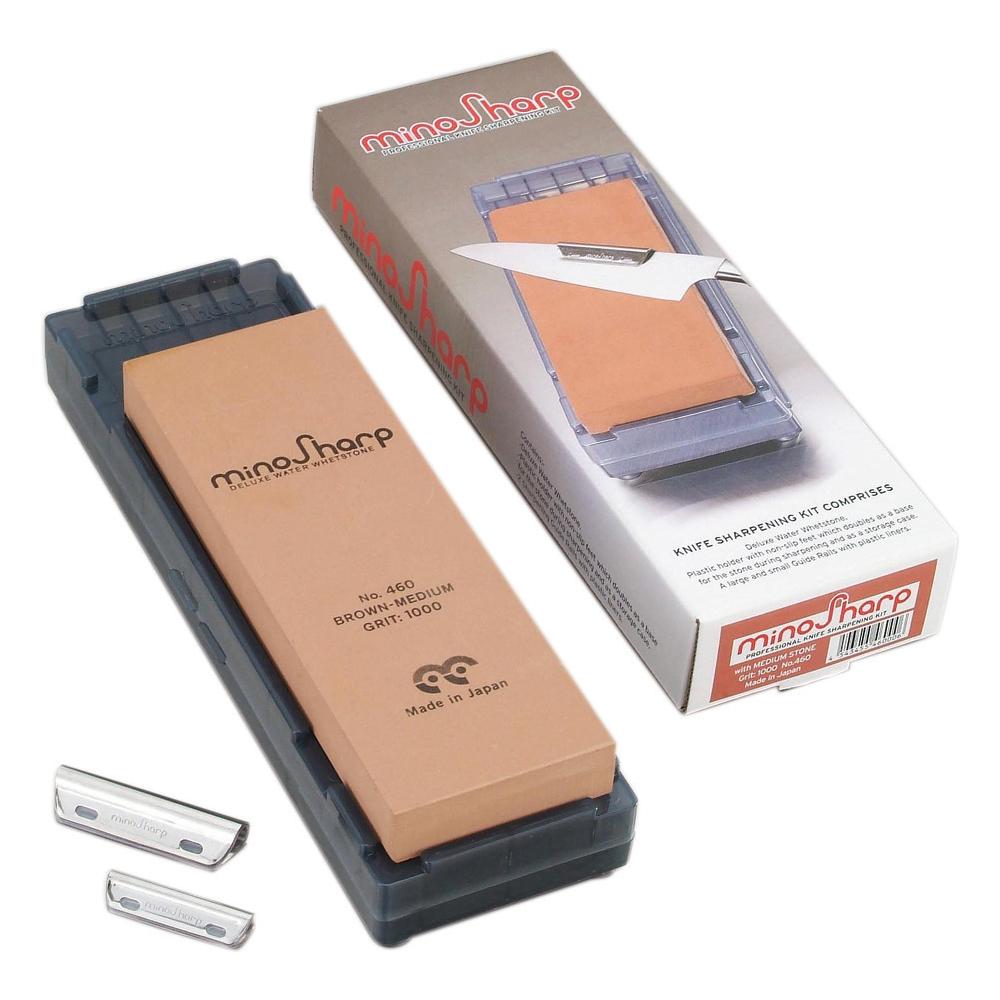
JIS1000: For removing the burr or for honing the knife / straightening the edge.
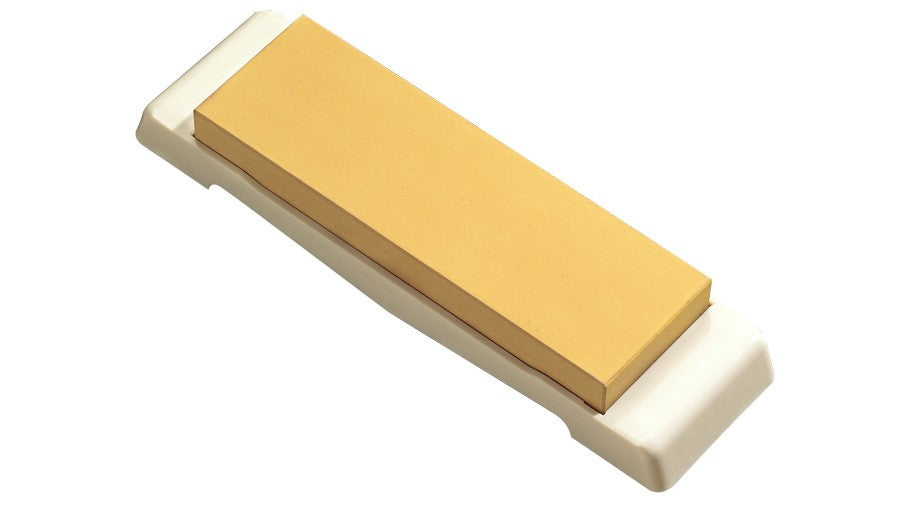
JIS3000: Used for fine sharpening and results in a finer edge. For knives that are still in good condition, you can also try this grit for simple honing.
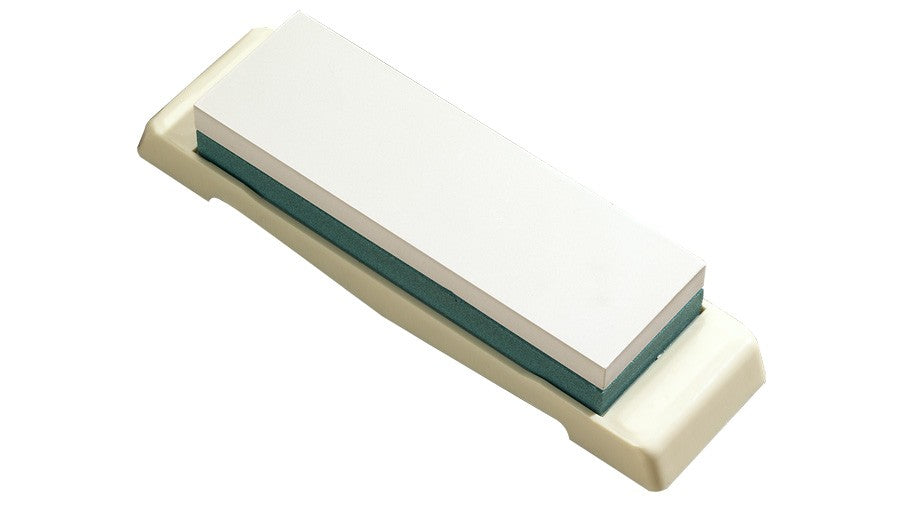
JIS6000: Ideal for polishing: only from this grit does a razor-sharp blade emerge that cuts paper just by pressure.
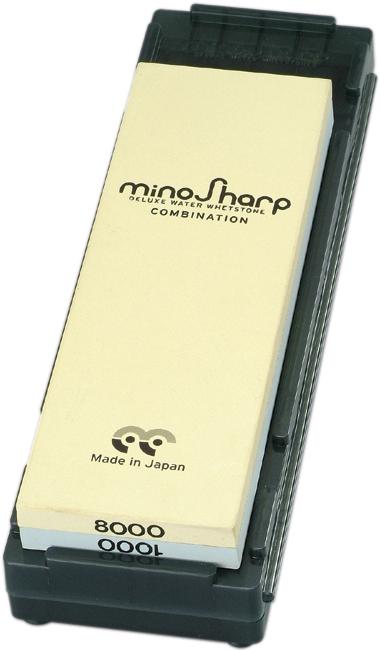
JIS8000 – 12000: High-gloss polish for extremely fine edges. Only makes sense if you have a knife with very good steel or for straight razors that require an extremely fine edge (61° HRC+ or carbon steel).
Leather strop with sharpening paste: Due to the elasticity of the leather, the edge becomes more stable. Depending on the grit of the sharpening paste, a good polish results.
First, you should check the condition of the knife. For knives that have chips or are so dull that they can no longer be sharpened by simply honing on a high-quality honing steel or sharpening stone, use a coarse stone, around 240 grit, to establish a basic grind. If you only want to maintain the edge, a 1000 grit is sufficient.
6.3 When do I use which sharpening tool?
If the edge is very dull, it is recommended to pre-grind with a 240-grit stone until a burr forms. This is difficult for beginners to detect. With a little practice, even if it is very subtle, it can be seen with the naked eye. Otherwise, you can feel it by running your finger over the edge, from the spine of the knife towards the edge. If you feel something rough, that is the burr. If the burr can be felt evenly across the entire cutting edge, you can move to a higher grit to remove it. A 1000-grit stone is well suited for this. Depending on the desired sharpness, even higher grits can be used. The finer the edge, the better the knife "grips" the material being cut. For a particularly good result, a leather strop with polishing paste is suitable. This can be used instead of a high-quality sharpening stone (around 6000 grit). It is also suitable for simply stropping high-quality knives – depending on the condition of the edge.